Your Cart is Empty


Quick Summary
Warm dining lighting comes from a low pendant over the table, bulbs around 2700K to 3000K, and layered lamps and wall lights around the room. Pair the pendant with a dimmer so you can lower the glow for dinner and raise it for clearing up.
Dining lighting does more than help people see their plates. It sets the feel of the whole room. A warm, low glow makes a dinner table feel like the heart of the home, while harsh overhead light makes the same space feel like a waiting room. Warm white light between 2700K and 3000K is widely described as comfortable for most homes, and that range is a good place to start (Glowryte's 2026 guide to home lighting trends).
At Ubercool, we think of the dining room as the place where lighting does its most personal work. The light sits low, the people sit close, and the conversation tends to run long. The right fixture makes that moment feel easy.
Here is what dining lighting usually needs to do:
Most rooms fail on the second point. They get the first right and forget the mood. A single bright ceiling light can light a table, but it rarely makes anyone feel relaxed.
Colour temperature is the single biggest factor in how warm a dining room feels. Bulbs between 2700K and 3000K give a soft, golden glow that suits most dining tables. Cooler bulbs at 4000K and above feel crisp and energising, which can work in a busy kitchen but often feels cold over dinner.
Warm light is not the only option. Cooler tones can create a sleek, modern look, while warmer tones suit a relaxed, inviting feel (Crown Lighting Group on creating an inviting atmosphere). Restaurants use the same logic. Warmer light is linked to intimacy, while cooler light feels more lively (Flipdish guide to lighting temperature for restaurants).
Our simple rule for dining rooms:
For the warm amber glow, a vintage Edison-style bulb is hard to beat. The Vintage Edison Bulb Dolly E27 gives a rich, round glow that makes any fitting look like a feature.

The table below sums up the colour temperature options covered in this section.
| Colour temperature | Best for | Feel |
|---|---|---|
| 2700K | Evening meals | Cosiest choice |
| 3000K | Dining rooms that double as workspaces | A little brighter |
| 4000K and up | Kitchens and task areas | Crisp and energising |
A pendant that hangs at the wrong height can ruin an otherwise beautiful table. Hang it too high and the light spreads out without warming the table. Hang it too low and it blocks sightlines across the table. A general starting point is to set the base of the shade roughly 700 to 800mm above the table surface, then adjust once you can see it in place.
Size matters as much as height, and this is where most guides stay vague. A useful rule of thumb is that the pendant's diameter should be about half to two-thirds the width of the table. For a 1.2m-wide table, look for a shade around 600 to 800mm across. For a long table, a single large shade or a row of two or three smaller ones works better than one tiny pendant. If you are using a row, space the fittings evenly and leave roughly 600 to 900mm between the edges of each shade so the light pools overlap.
A few more measurements worth checking before you commit:
Watch out: a pendant hung by eye often ends up 100 to 200mm too high, which is enough to lose the warm pool of light on the table. Measure from the table surface, not the floor.
The Ripple White Pendant has a handblown opaque glass shade that spreads a soft, ripple-like glow.

One light source rarely creates a warm dining room. Layering gives the room depth. Combine an overhead pendant for the table, a lamp for the sideboard, and wall lights for the edges of the room. Each layer does a different job, and together they make the room feel finished.
The overhead pendant lights the table. A table lamp or sideboard lamp adds a softer, lower pool of light that makes the room feel cosy. Wall lights bring light to the walls and corners, which stops the room feeling flat and dark at the edges. A few wall lights styled well can make a big difference to the atmosphere.
Try this layering approach for a warm dinner setting:
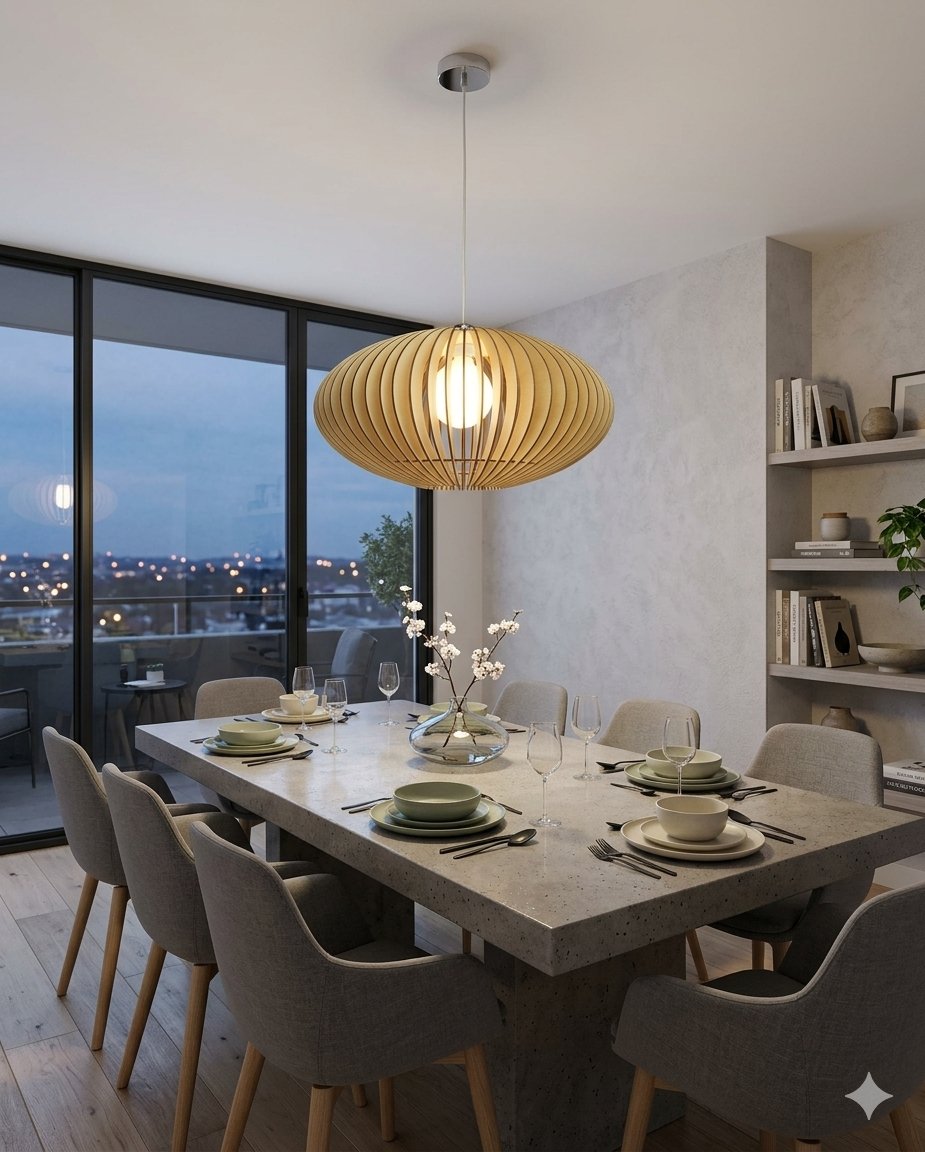
The right fixture should match the room, not just the trend. Warm dining room lighting can suit many styles, from clean modern lines to a more organic, natural feel. The key is picking materials and finishes that already appear in your home.
Natural materials remain popular for dining rooms. Wood, glass and warm metals all bring a soft, welcoming look. Sculptural shapes and organic forms are also showing up in 2026 home-lighting guides, and they can make a dining room feel like a design statement (Lustria's guide to 2026 light fixture trends).
For a warm, layered look, try:
The Globe Copper pendant has a copper finish and glass globe that catch the light from every angle. A warm Edison bulb can deepen the amber tones.
A dimmer is the simplest tool for a warm dining room, but not every dimmer works with every bulb. If you are fitting LED bulbs, check that the bulb is marked as dimmable and that your dimmer is compatible with LED loads. Older dimmers designed for halogen bulbs can cause flicker or buzzing with LEDs.
Once the dimmer is in, set a few scenes you can return to:
Glare is the next thing to watch. A bare bulb in your line of sight can make the table uncomfortable, so choose fittings that shade the bulb. Light that is spread across the table, rather than aimed straight down, tends to flatter both people and food. Opal glass, fabric shades and deep-set bulbs all help.
Food also needs good colour. Warm bulbs make bread, roast meat and fresh salads look appetising, but very yellow light can make greens look dull. Look for a colour rendering index (CRI) of 90 or above alongside your 2700K to 3000K colour temperature.
Watch out: if a dimmer flickers at low levels, check compatibility before your next dinner party.
Do not wait until the guests arrive to test your lighting. Set aside an evening to try your setup in the room where people will actually sit. Switch on the pendant, the lamp and the wall lights, then dim them to the level you like. Sit at the table and check that you can see each other and the food.
A short checklist helps:
Once everything feels right, you can relax and enjoy the evening. A warm, well-lit dining room makes people linger over dessert and coffee. That is the real goal of good dining lighting.
If you are ready to start, browse our range of pendants and bulbs and find the piece that suits your table. Our team is happy to help you choose.
Choose bulbs in the warm white range of about 2700K to 3000K, which is widely described as comfortable for most homes. Use a pendant or chandelier above the table for focus, then add a table lamp or wall light to soften the edges of the room. Fit a dimmer so you can lower the brightness as the evening goes on. Warm light flatters skin tones and makes a dining room feel like a place to linger rather than a space to rush through.
For most dining rooms, a warm white between 2700K and 3000K creates an intimate, relaxed feel. Cooler light at 4000K and above can feel energising but may make a room feel clinical during a meal. If your dining area doubles as a workspace, you might use a slightly cooler bulb in an additional fitting and keep the main pendant warm. Test a bulb in your own space before committing, since walls and finishes change how light looks.
A common starting point is to hang the pendant so its lowest point sits around 70 to 80 centimetres above the tabletop, adjusting for the height of the fixture and the height of the people who will sit beneath it. Lower pendants feel cosier, while higher ones suit larger rooms or taller ceilings. Check sightlines so guests can see across the table without the fixture blocking their view.
Yes. A dimmer is one of the simplest ways to shift a dining room from bright and practical to warm and intimate. Lower the light for dinner, raise it for cleaning up or homework. Make sure the bulbs and the dimmer are compatible, as not all LEDs dim smoothly. Layering a dimmable pendant with a dimmable lamp gives you far more control over the atmosphere.


