Your Cart is Empty


Last Updated: November 9, 2026
Quick Summary
Minimalist lighting works in NZ homes by removing visual noise so light itself becomes the feature, using clean lines and a restrained palette to make rooms feel calmer and larger. Keep it warm with colour temperatures around 3000K, a CRI of 90 or above, and dimming for evening atmosphere.
Modern minimalist lighting for NZ homes works because it removes visual noise and lets light itself become the feature. Clean lines, simple silhouettes and a restrained palette make a room feel calmer and larger, which is exactly what open-plan living demands.
At UBERCOOL, we've spent over 16 years helping homeowners choose pieces that do this well. Generous glazing, timber floors and pared-back interiors all reward fixtures that don't compete for attention, and that principle holds whether you're lighting a new build or a renovated villa.
The trick most people miss is that minimalism is not the same as cold. Warm materials, warm colour temperatures and a little layering do the softening work.
Minimalist pendant lights are the quickest way to give a room a focal point without adding clutter. A single well-chosen pendant does more than three small fixtures scattered across a ceiling.
The MUMU 1200 LED Pendant is a strong choice for long surfaces. At 1200mm long, the satin white aluminium body with warm beechwood ends creates a clean horizontal line above a table or island, and the built-in dimmable 32W LED at 3000K gives even light without visible bulbs. It's $959.00 in white, or $989.00 in matt black with walnut ends.
Linear shapes suit long surfaces because they spread light along the whole length rather than pooling it in one spot. If you're planning pendants over an island, the height and spacing matter as much as the style, and our guide to which pendant lights work best for a kitchen island walks through both.
Small pendants earn their place in threes. The Qin Pendant Black is 70mm across with a beech timber cap and a built-in 5W LED at 3000K, and at $99.00 it is an accessible option for a bedside or narrow island. The Funnel Pendant, also $99.00, is handcrafted from natural basswood and diffuses light softly, which makes it a gentle choice for a reading corner.
Layered lighting means combining ambient, task and accent light so a room can shift from bright and practical to soft and restful. One ceiling fixture alone flattens a space; three layers give it depth. The concept is simple, but the useful part is knowing which layer each room is usually missing and what to put there.
Start with ambient light for general brightness, add task light where you read, cook or work, then finish with accent light to wash a wall or highlight a texture. The Basswood White Pendant at $329.00 handles ambient warmth beautifully, thanks to its natural woodgrain interior that glows when lit. For the underlying method, our seven steps to layer lighting in your living room breaks the process down.
| Layer | Job | Typical Fitting | Where It Goes |
|---|---|---|---|
| Ambient | Overall brightness | Pendant or ceiling light | Centre of room |
| Task | Focused light for work | Wall light or adjustable pendant | Desk, bedside, bench |
| Accent | Depth and drama | Wall light or up-down fitting | Blank walls, alcoves |
Most lounges already have ambient light from a ceiling fitting and are missing accent light. A wall light washing the chimney breast or a dark corner adds depth without another ceiling hole. If the room is open-plan, treat the lounge and dining zones as separate layers so each has its own focal point rather than one bright ceiling doing everything.
Kitchens need all three layers working at once. Ambient comes from ceiling or recessed light, task comes from pendants over the island and bench, and accent can come from under-cabinet strip light or a wall light grazing a splashback. A linear pendant over the island is the workhorse here because it spreads task light along the whole surface rather than pooling it in one spot.
Bedrooms are the reverse of kitchens: ambient light should be low and dimmable, and task light does the real work. A swivel wall light beside the bed gives focused reading light without a table lamp taking up surface space, and a small pendant or two on either side keeps the ceiling calm. Keep colour temperature warm here so the room settles in the evening.
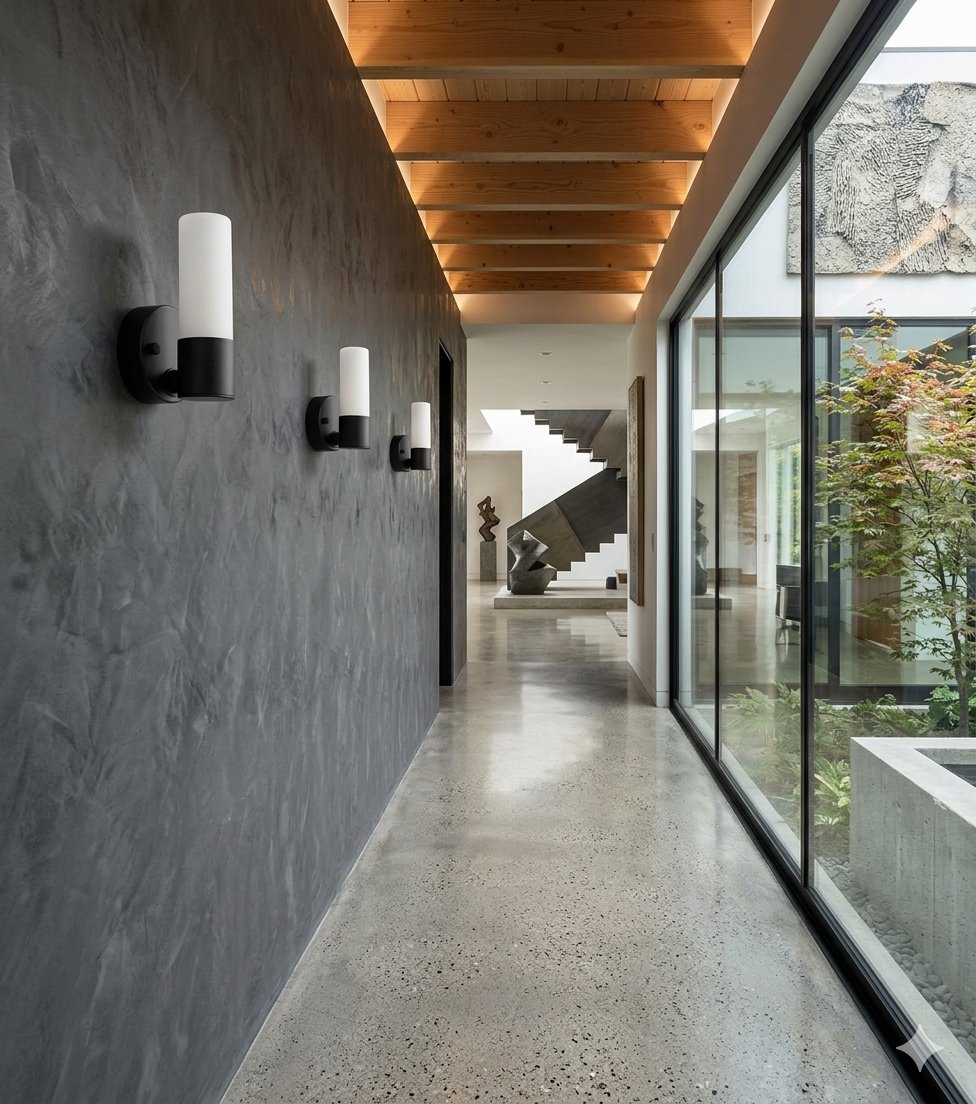
Hallways rarely need task light but benefit hugely from accent. A slim wall light that sends light up and down a wall adds height and makes a narrow passage feel less like a corridor. This is also where a single sculptural fitting earns its keep, because there is no furniture to compete with it.
Watch out: layering is not the same as adding more fittings. If two layers are already doing their job, a third fixture often just adds glare and visual noise. Add a layer only when you can name the job it is doing.
Lighting for small rooms comes down to one rule: fewer, better fixtures. A single sculptural piece reads as intentional; five small ones read as busy.
Low ceilings are the usual worry. A slim linear pendant or a flush wall light keeps sightlines clear, and wall-mounted options free up ceiling space entirely. The Facet White Wall Light is 30mm deep and sends shafts of light from both ends. At $89.00 it's the least expensive way to add architectural interest to a hallway or bedroom.
Watch out: hanging a pendant too low over a dining table in a small room makes the space feel compressed. Keep the bottom of the shade clear of eye level when people are seated.
Wall lights add depth because they light surfaces rather than the middle of the room. A wash of light down a wall makes a space feel wider and taller, and it costs far less than adding another ceiling fitting.
The Mumu Wall Light suits reading nooks and bedside use. Its swivel head rotates 160 degrees, and the integrated 5.7W LED delivers 400 lumens at 3000K with a CRI of 90, which keeps skin tones and timber looking natural. It's $479.00 in silky white or silky black, both with walnut wood detailing. Pair it with our seven wall light styling rules that actually work so the result looks deliberate.
Prices of minimalist lighting fixtures
Colour temperature, CRI and dimming decide whether minimalist lighting feels warm or clinical. Get these right and almost any fitting will look good. The specifications on the box are not marketing decoration; they are the difference between a room that feels calm and one that feels like a waiting room.
Colour temperature is measured in kelvin.
Two more specs are worth understanding before you buy:
The Mumu pendants and wall lights are rated at 3000K, and the pendants are dimmable. If warmth and dimming are your priority, our guide to creating a warm atmosphere with dining lighting shows how those specs translate at the table.
New fixed lighting work is generally carried out by a licensed electrician. That is not a reason to avoid a project; it is a reason to plan the electrical work alongside the design rather than after it.
Dimming deserves a specific check. Not every dimmable LED plays nicely with every dimmer switch, and an incompatible pairing can cause flicker or a faint buzz.
Watch out: a fitting rated at 3000K and CRI 90 will still look wrong if it is the only light source in a room with cool white downlights. Match colour temperature across fittings in the same space, or the mismatch will be obvious at night.
Choosing minimalist lighting is easier when you work from the room outward rather than from a catalogue inward. Decide the layer you're missing, match the finish to your existing materials, then check the specs.
A simple checklist before you commit:
One honest limitation: integrated LED fittings aren't a swap-a-bulb proposition, so buy for the long term rather than for a trend. If you want to check your choices against what's current, see what lighting trends will define NZ homes in 2026.
For most homes, we'd start with one linear pendant over the main gathering space and two wall lights for depth, then build from there. Minimalist lighting rewards restraint, and a small number of well-specified pieces will always beat a room full of fixtures.
Getting the layers right takes a little thought, and that's where we can help.
Modern minimalist lighting strips a fitting back to its essential form: clean lines, simple silhouettes and finishes like satin white, matt black or natural timber, with function over decoration. It tends to mean fewer, larger pieces rather than many small ones, and integrated LED or dimmable options so one fitting can shift from bright task light to a soft evening glow. The aim is light that shapes the room without the fixture competing for attention.
Warmth comes from three things: colour temperature, materials and dimming. Choose 3000K warm white rather than cooler tones, and look for natural finishes such as beechwood, walnut or basswood that glow when lit. Dimming matters just as much, because a room at full brightness at 9pm feels clinical. A dimmable pendant above a dining table, turned low, does more for atmosphere than any amount of styling.
Match the pendant to the island or table it hangs over. A long island suits a linear piece such as the MUMU 1200 LED Pendant at $959, which is 1200mm long. Smaller islands or breakfast bars can take a cluster of two or three compact pendants instead. Keep the drop consistent, leave clear sightlines across the room, and pick one finish that ties to your tapware or cabinetry.
Use fewer fittings and let each do more than one job. A single dimmable pendant can serve as a main light, and a slim swivelling wall light such as the Mumu Wall Light at $479 can provide reading light. Keep finishes consistent, mount wall lights at the same height, and avoid mixing more than two materials in a compact room.
Recessed LEDs are common in new-build design and suit minimalist rooms because they disappear into the ceiling. The trade-off is that they give flat, even light with no focal point, so pair them with a pendant over the table or island and a wall light for accent.


