Your Cart is Empty


Last Updated: November 1, 2026
Quick Summary
The lighting trends defining NZ homes in 2026 centre on warm, layered lighting: rooms are lit in three dimensions rather than from a single ceiling fixture, and colour temperatures are moving steadily warmer. Layered lighting combines ambient, task and accent light, with warm LED around 2700K to 3000K and CRI 90+ keeping spaces energy-efficient.
The shift toward warmer, layered lighting is the defining story of lighting trends for NZ homes in 2026.
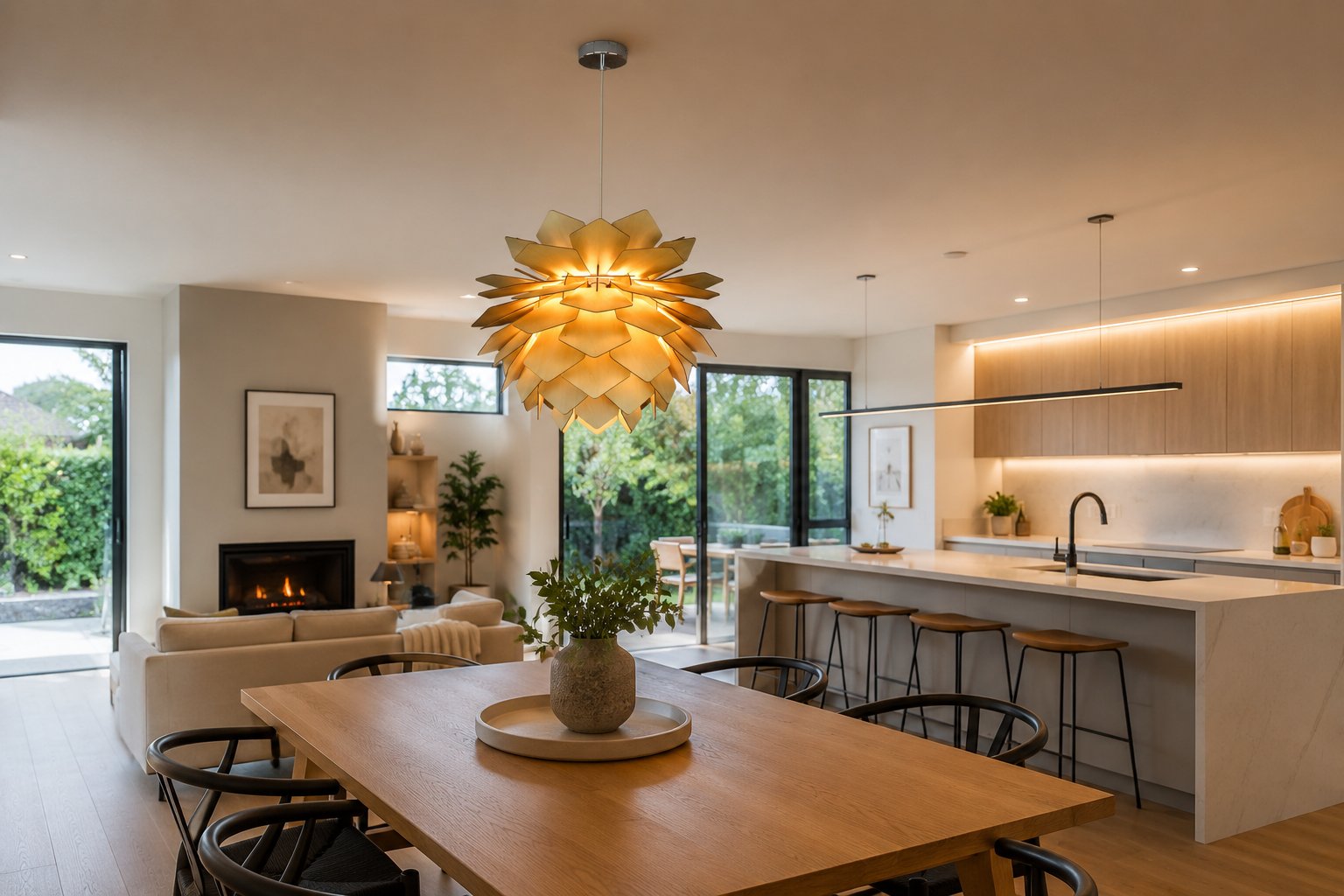
Homeowners increasingly ask how a room should feel at 7pm in winter, and what it takes to get there.
The answer almost always involves layers. Lighting Direct's 2026 trend forecast calls layered lighting a must-have for the year, and that matches what we see in the enquiries that come through our door.
Here is the throughline for everything below: 2026 lighting is about atmosphere first, fixture second. Get the layers and the warmth right, and almost any fitting will look good in the room.
Layered lighting for the home means combining three distinct jobs in one room: ambient light to fill the space, task light where you work, and accent light to shape mood and highlight detail. Each layer does something the others cannot.
Ambient light is your base. A pendant or a pair of ceiling fittings does this job, ideally on a dimmer so the room can soften after dark.
Task light follows activity. Reading, cooking, chopping, homework. A wall light beside a bed or a pendant over an island earns its place here.
Accent light is the layer most homes skip, and it is the one that makes a room feel designed. A floor lamp washing a corner, a small table lamp on a shelf, a picture light grazing a wall.
If you want this mapped room by room, our guide to why quality lighting matters for homes walks through each space and the layers that suit it.
Layer |
Job |
Typical fittings |
Where it matters most |
|---|---|---|---|
Ambient |
Fills the room with general light |
Pendants, ceiling fittings, chandeliers |
Living areas, bedrooms |
Task |
Lights the work in front of you |
Wall lights, pendants over benches, table lamps |
Kitchens, desks, bedside |
Accent |
Shapes mood and highlights detail |
Floor lamps, small table lamps, picture lights |
Corners, shelves, hallways |
The most inviting living rooms in 2026 share one habit: they never rely on a single overhead light after dark. Instead, three or four small sources at different heights do the work together.
Start with a pendant or chandelier as the anchor, then add a floor lamp behind a sofa and a table lamp on a sideboard.
Wall lights are the quiet hero here. They free up floor space and throw light upward, which makes ceilings feel taller. Our wall light styling rules cover spacing, height and pairing in plain terms.
One mistake we see often: matching every fitting in the room. A little contrast in shape and material reads as collected rather than showroom.
Timber, natural stone, alabaster and artisan glass are the materials of the moment, and sculptural forms are how they show up.
The Basswood Natural pendant is a good example of the mood. Natural organic basswood, a matt finish that lets the grain speak, and a simple round form that suits a dining table or a hallway.
For something with more presence, the Bach Curve White Pendant uses white basswood in an open, curved structure that filters light through the wood.
Houzz's 2026 lighting trend coverage notes repeated geometric forms, stacked discs and spheres among the shapes coming through, and that rhythm is easy to copy at home: repeat one shape rather than mixing five.
See the Basswood Natural pendant

Yes, an arc floor lamp can work well in a small room, provided the base is compact and the arc reaches over furniture rather than into walkways. The trick is placing the base behind or beside a sofa so the arm reaches the seating area without eating floor space.
Three checks before you buy:
In practice, an arc lamp can replace both a table lamp and a ceiling light in a tight lounge. Watch out: a wide base in a narrow room becomes a trip hazard, so check the footprint before you commit.
An arc lamp is only as good as the light it throws, and this is where most buyers get caught.
Colour temperature. For a living room you want warm light, around 2700K to 3000K.
Colour rendering. Look for a CRI (colour rendering index) of 90 or above. A high-CRI lamp makes timber, linen and skin tones look natural rather than grey.
Lumens, not watts. Watts tell you energy use, lumens tell you brightness. A reading arc lamp typically wants somewhere in the 400-800 lumen range at the shade, dimmable, so it can drop lower for ambience.
Dimming compatibility. If you plan to put the lamp on a smart plug or a wall dimmer, confirm the driver is dimmable and compatible.
A few practical habits make an arc lamp earn its floor space:
If the room is genuinely tight, a wall light with an adjustable arm does the same job without a base at all. Our wall light styling rules cover spacing and height for that option.
Warm LED lighting is the practical answer to the energy question, and 2026 fittings make it easy to get right. Look for a colour temperature around 3000K for living spaces, and dimmable drivers so the light can drop lower in the evening.
The MUMU 1200 LED Pendant White is built for this. A 120cm satin white aluminium body with warm beechwood ends, 32W LED output at 3000K, and dimmable.
If you are working with existing E27 fittings, the LED Teardrop 4W gives you the vintage filament look at 4W with a 50,000 hour lifespan. Small change, real difference on the power bill.
Warm LED is not one thing. Four specifications separate a fitting that makes a room glow from one that makes it feel like a waiting room.
Colour rendering (CRI). Aim for 90+. Below 80, timber looks muddy and food looks unappetising. This matters most over a dining table or kitchen island, where you look at what you are eating.
Lumens. Match brightness to the job rather than the wattage. As a rough guide, a dining pendant wants enough light to see faces clearly without glare, while a bedside lamp wants far less.
Dimming. Confirm the driver is dimmable and that your switch or smart system is compatible. Trailing-edge dimmers suit most modern LED drivers; leading-edge dimmers can cause buzz or flicker.
LED fittings use a fraction of the energy of the halogen and incandescent bulbs they replace, and they last for years rather than months. The practical effect is that the cost of a fitting is mostly the fitting itself, not the electricity or the replacement bulbs. A 4W LED doing the job of an old 40W bulb is the clearest example: same light, a small share of the running cost, and no ladder to change it every season.
A sensible approach is to spend on the anchor piece and choose warm, dimmable, high-CRI LED for everything else. The light quality is what you notice every evening; the efficiency is what you notice on the bill.
Shop the MUMU 1200 LED Pendant White

The pieces that age well are rarely the loudest ones. They tend to share three traits: honest materials, a simple silhouette, and a finish that matches the house rather than the season.
A good rule of thumb is to spend on the anchor and save on the accents. A sculptural pendant over a dining table earns its price because you look at it every day. Trend-led accents can be swapped in a weekend.
Ask yourself three questions before buying:
If the answer is yes to all three, you are buying something you will still like in 2031. Our buyer's guide to curated designer fixtures goes deeper on how to judge quality before you commit.
The strongest direction for 2026 is layered lighting, where ambient, task and accent light work together rather than relying on one central fixture. Warm architectural lighting, natural-material finishes and quietly sculptural forms are also shaping homes. You will see repeated geometric shapes, timber and glass, and dimmable LED pieces that let a room shift from bright and practical to soft and atmospheric depending on the time of day.
Start with one ambient source, such as a pendant or chandelier, then add two smaller layers: a task light for reading and an accent light to highlight a corner or artwork. Keep finishes consistent, like warm timber or matt white, so the pieces feel related. Dimmable options help you control the mood. A wall light or a portable table lamp can add warmth without taking up floor space, which matters in smaller rooms.
They can be, because the curved arm reaches over a sofa or chair without needing a large base footprint. The key is choosing a slim profile and placing it so the arc lands where you actually need light, rather than in a walkway. In a compact living room, an arc lamp can replace a side table lamp and free up surface space, while still giving you a warm pool of light for reading or relaxing.
Yes, especially warm LED options. Modern LEDs come in warm colour temperatures that avoid the cold, blue-toned look older bulbs had. They use far less power than halogen or incandescent equivalents, and fittings like the MUMU 1200 LED Pendant have dimmable LED built in. For pendant lights and bedside lamps, a warm LED teardrop bulb gives you the vintage look with modern efficiency and a long lifespan.
The real challenge with 2026 lighting is not finding beautiful pieces. It is choosing a set that works together, in your rooms, on your budget. That is the part we enjoy most. UBERCOOL has spent over 16 years personally selecting designer pendant, floor, table and wall lighting, and we are happy to talk through your plan before you buy. Get started with UBERCOOL and light your home the way it deserves.


